
By Alex Ooley | Forge of Freedom
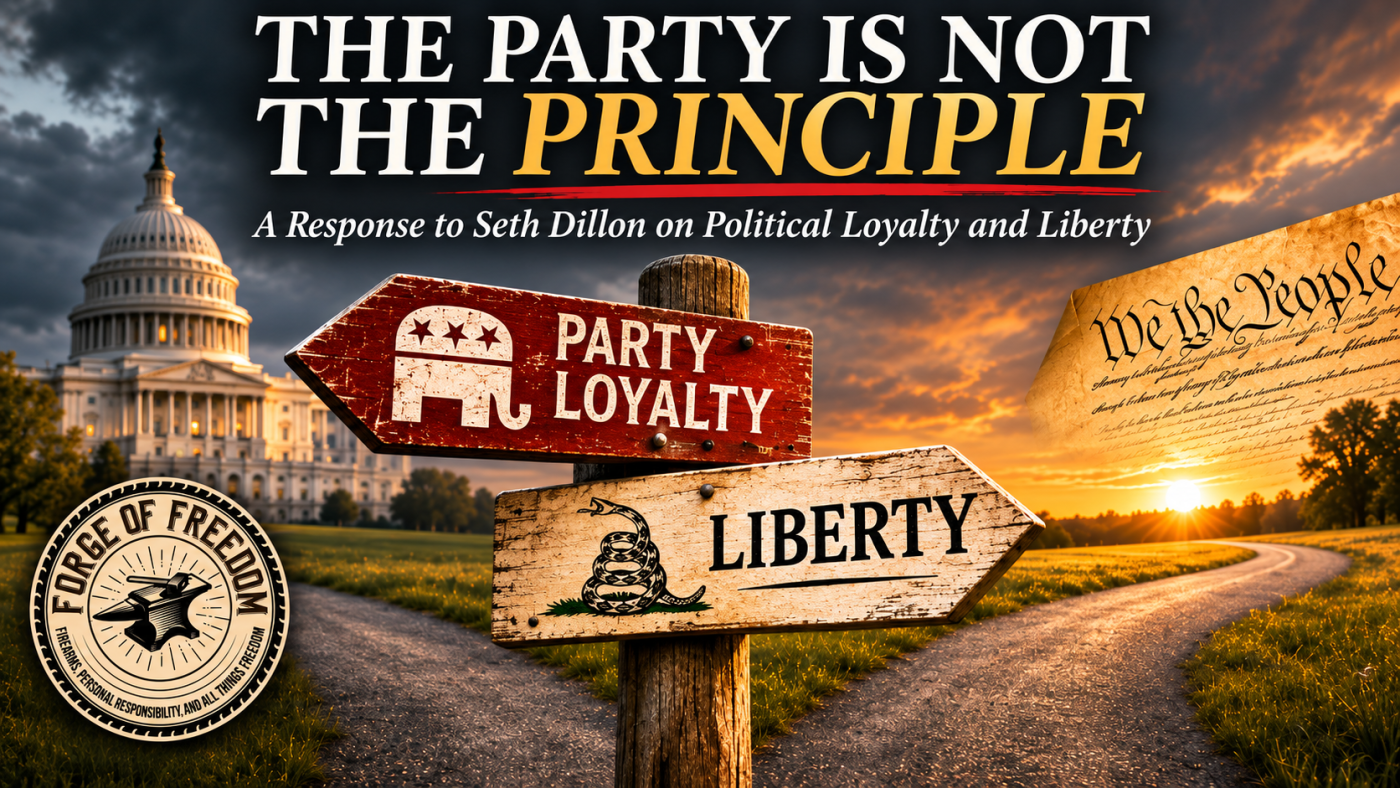
The Republican Party is not an end in itself. It is merely a means to advance certain principles, or at least it ought to be.
That distinction seems increasingly lost in American politics, where loyalty to a political party is too often treated as a virtue greater than fidelity to the principles the party supposedly represents.
On November 9, 2026, Seth Dillon, CEO of The Babylon Bee, offered an interesting illustration of this problem in a post on X.
Dillon argued that while neoconservatives may be wrong about foreign policy, and their positions may even hurt Republicans electorally, they deserve some credit because “at least they vote Republican.”
He contrasted them with members of the so-called “new right” who encouraged their followers to vote for Democrats, celebrated Democratic victories, and claimed credit for helping produce those results.
According to Dillon, the neoconservatives’ harm to the Republican Party was unintentional, while the actions of their critics amounted to deliberate sabotage.
He concluded that rewarding those critics with leadership positions would be tantamount to embracing the people responsible for the party’s defeat.
But Dillon’s argument rests on an assumption that deserves considerably more scrutiny: that the success of the Republican Party is itself the objective.
For those of us who believe in limited government, individual liberty, fiscal responsibility, constitutional restraint, and a foreign policy that respects the limits of American power, that assumption gets the relationship between principles and politics exactly backward.
Seth Dillon’s Mistaken Measure of Loyalty
Dillon is certainly entitled to criticize people who actively encouraged voters to support Democrats. There are legitimate arguments about electoral strategy, political consequences, and whether particular tactics advance or undermine a movement’s objectives.
But his distinction between neoconservatives and their critics misses something more fundamental.
Dillon is essentially arguing that neoconservatives, whatever their faults, remain loyal to the Republican Party, while their critics are guilty of deliberately undermining it.
That might be persuasive if electing Republicans were the ultimate purpose of political participation. It is NOT.
The relevant question is not simply whether neoconservatives support Republican candidates. It is whether the policies they advance are consistent with the principles that supposedly justify supporting those candidates in the first place.
If neoconservatives consistently advocate military intervention abroad, support reckless federal spending, tolerate inflationary policies, and accommodate the expansion of federal power, why should they be rewarded simply because they wear the correct party label?
What exactly is being conserved? There is nothing “conservative,” in the literal sense, about these policies.
A Republican who supports unconstitutional exercises of government power does not somehow make those actions constitutional. A Republican who votes for another trillion dollars in debt does not make that debt fiscally responsible, and a Republican who advocates another unnecessary foreign intervention does not make that intervention consistent with a restrained foreign policy.
The party affiliation of the politician does not change the nature of the policy.
Dillon focuses on whether a faction’s conduct is intentionally harmful to the GOP, but those concerned with limited government have a different question: What happens when a faction intentionally advances policies that undermine the very principles the party claims to represent?
From that perspective, repeatedly expanding government power while maintaining Republican electoral loyalty is hardly an unqualified virtue, and calling dissenters saboteurs does nothing to resolve that contradiction.
Votes Are Earned, Not Owed
The notion that voters owe the Republican Party unconditional loyalty, regardless of its betrayals, turns representative government on its head.
In a constitutional republic, elected officials are supposed to be accountable to the people. Their authority is delegated, their powers are limited, and their continued service depends upon the consent of those they represent.
Political parties have no independent claim on that consent.
Votes are supposed to be earned, not owed.
If voters are expected to support a party regardless of its conduct, what incentive does that party have to honor its commitments?
A politician who knows that the electorate will reliably support him simply because the alternative is worse has little reason to worry about violating the principles he campaigned upon.
This creates a predictable problem. The party demands loyalty in the name of protecting certain principles while gradually abandoning the very principles that justified that loyalty in the first place.
Eventually, winning elections becomes more important than the reasons anyone wanted to win them.
And when principled voters object, they are accused of helping the opposition.
That accusation effectively transforms political parties from instruments of representative government into institutions to which the electorate is expected to remain obedient.
It is difficult to reconcile such an expectation with a philosophy grounded in individual liberty and limited government.
Is Dissent Really Sabotage?
Dillon characterizes the behavior of certain figures on the new right as deliberate sabotage.
To be fair, there is a meaningful distinction between someone who reluctantly withholds support from a Republican candidate and someone who actively campaigns for that candidate’s Democratic opponent.
Those decisions may have different consequences, and it is reasonable to evaluate them differently.
But Dillon’s argument leaves unanswered a more important question: At what point does withdrawing support from an unprincipled political party become a legitimate exercise of political accountability?
Consider a Republican voter who believes that federal spending is out of control, that American foreign policy has become dangerously interventionist, and that the federal government routinely exceeds its constitutional authority.
Suppose that voter repeatedly supports Republican candidates who promise to address those problems, only to watch them perpetuate the same policies once elected.
How many times must that voter repeat the exercise before he is permitted to conclude that the party has failed to represent his interests?
And if he finally refuses to support another candidate who advocates those same policies, has he sabotaged the Republican Party?
Or has the Republican Party simply failed to earn his vote?
There is a legitimate strategic argument for supporting imperfect candidates. Elections involve tradeoffs, and voters should consider the practical consequences of their decisions, but strategic considerations cannot be allowed to become an unlimited demand for political obedience.
If every refusal to support a Republican is treated as an unacceptable betrayal, then voters have surrendered one of their most meaningful means of holding that party accountable.
Indeed, there is a certain irony in accusing dissenters of sabotaging a political movement while excusing those who have spent years advancing policies contrary to its professed principles.
The Libertarian Warning: Power Is Not the Objective
Murray Rothbard understood something that modern partisan politics frequently obscures: political power is not itself the objective of a movement dedicated to liberty.
Power may be used to advance freedom, but it can just as easily become an excuse to abandon it.
A movement that measures its success primarily by the number of offices occupied by its preferred political party risks confusing political victories with philosophical progress.
Winning the White House means little for the cause of limited government if the federal government continues growing.
Controlling Congress is hardly a triumph for fiscal conservatism if Congress continues spending money it does not have.
Claiming to defend the Constitution rings hollow when constitutional limitations are treated as inconveniences whenever they interfere with a preferred policy.
Thomas Massie’s approach to politics offers a contemporary illustration of the tension between party loyalty and constitutional principle. His willingness to oppose Republican leadership on matters such as federal spending, surveillance, and war powers reflects the proposition that a representative’s obligations extend beyond advancing his party’s immediate political objectives.
One need not agree with every position Massie takes to recognize the importance of the distinction.
The relevant question should never be merely whether Republicans or Democrats control the machinery of government.
It should be whether that machinery is becoming more restrained, more accountable, and more respectful of individual liberty.
That is a fundamentally different measure of political success.
The Constitution Is Not a Partisan Document
The Constitution does not grant additional authority to government officials because they belong to a particular political party.
The limitations on federal power apply equally to Republicans and Democrats.
Congress does not acquire authority to disregard its constitutional responsibilities over war simply because the president belongs to the same party.
Deficit spending does not become responsible when supported by politicians who campaign as fiscal conservatives.
And executive overreach does not become acceptable simply because the executive shares our political preferences.
Yet American political discourse frequently treats constitutional principles as weapons to be deployed against the opposing party rather than restraints that bind everyone.
This is particularly dangerous because the expansion of government power rarely remains confined to those who first exercise it.
Every authority that one administration claims for itself becomes available to the next.
Those who celebrate extraordinary government powers when their preferred party controls Washington should consider how they will feel when those same powers are exercised by their political opponents.
The solution is not merely to ensure that the right people wield government power.
It is to limit that power in the first place.
The Real Danger to the Republican Party
Dillon worries that rewarding those who undermined Republican candidates would be destructive to the conservative movement.
But there is another danger he seems to overlook.
What becomes of a political movement when its members are more concerned with preserving the party’s power than with preserving its principles?
What happens when the party can count on the support of voters who have nowhere else to go, no matter how frequently it disappoints them?
And what incentive exists for reform when every effort to impose electoral consequences is characterized as betrayal?
It is possible to believe that helping elect Democrats would produce undesirable policy consequences while simultaneously recognizing that Republican loyalty is not an end in itself.
These positions are not mutually exclusive.
Nor does rejecting the demand for unconditional Republican loyalty require endorsing the Democratic Party.
There is considerable room between blind partisanship and support for the opposition. That space is where political independence, principled dissent, and genuine accountability reside.
The Republican Party should not be immune from criticism simply because its critics also oppose the Democratic Party.
If Republicans want the support of voters who believe in limited government, constitutional restraint, fiscal responsibility, and nonintervention, they should advance those principles.
And if they lose elections because they abandon those commitments, the responsibility should not automatically be assigned to the voters who refused to surrender their convictions.
Liberty Is the Objective
Ultimately, my disagreement with Dillon is not about whether Republican victories or Democratic victories have consequences. Of course they do.
Nor is it about whether political strategy matters. It certainly does.
It is about what we are trying to accomplish through politics in the first place.
The Republican Party is not an end in itself. It is merely a means to advance certain principles—or at least it ought to be.
Those principles must remain the standard by which the party is judged.
For Americans who value individual liberty, limited government, constitutional restraint, and fiscal responsibility, political independence is not necessarily a refusal to participate in the political process. It can instead be a refusal to allow that process to dictate one’s principles.
There is nothing inherently virtuous about supporting a Republican simply because he is a Republican. Nor is there anything inherently virtuous about opposing a Democrat simply because she is a Democrat.
The substance matters more than the label.
And if a political party abandons the very principles that once justified supporting it, the blame for its electoral failures cannot simply be placed on those who eventually withdraw their support.
The goal isn’t to elect a particular party.
The goal is liberty.
Democrats lost sight of that long ago. Republicans have increasingly done the same.
Perhaps the first step toward recovering the principles of limited government is recognizing that neither political party is entitled to our loyalty.
Our allegiance should belong to the Constitution, to individual rights, and to the fundamental proposition that government exists to protect liberty—not the other way around.
Political parties are instruments. Liberty is the principle.
We should never sacrifice the latter to preserve the former.
