

The celebration over Thomas Massie’s primary defeat tells us something important about the current state of Republican politics, but not what his critics think it does.
One post celebrating Massie’s loss called it a “crushing blow to Democrats everywhere,” a “great victory for the Constitution,” and the end of being “held hostage by a pretend-conservative whose WORDS purport to promote GOP freedom but whose every ACTION promotes Democrat tyranny.”
Crushing blow to Democrats everywhere.
Great victory for the Constitution, for liberty and for the future success of America.
No longer will we be held hostage by a pretend-conservative whose WORDS purport to promote GOP freedom but whose every ACTION promotes Democrat tyranny.… pic.twitter.com/iK4kzJ9RNZ
— Cynical Publius (@CynicalPublius) May 20, 2026
That framing is not merely wrong and exaggerated. It is exactly backwards.
Thomas Massie was not a pretend conservative. He was one of the few Republicans in Congress who consistently applied conservative principles when doing so was inconvenient, unpopular, or costly. He opposed massive deficit spending. He opposed bloated continuing resolutions and omnibus bills. He opposed blank-check foreign aid. He opposed gun control and civil-liberties erosions buried in must-pass legislation. He was willing to say “no” when both parties wanted to keep Washington operating as usual.
That is precisely why he earned the reputation of “Mr. No.”
In an era when many politicians define conservatism as loyalty to a person, a party, or a media narrative, Massie defined it more traditionally: fidelity to the Constitution, limits on federal power, skepticism toward debt, and a refusal to fund every project that can be packaged as urgent, patriotic, or inevitable.
That is not Democrat tyranny. That is constitutional conservatism.
The record bears this out. During the 117th Congress, Massie voted with President Joe Biden’s stated position only 1.8% of the time, tying with Chip Roy for the lowest Biden-agreement score in Congress. That statistic alone should end the lazy claim that Massie was somehow a functional Democrat. The later ABC/FiveThirtyEight methodology explains that these presidential-agreement scores measure votes where the president had taken a clear position, and in 2023 the average House Republican voted with Biden only 5% of the time. Massie’s 1.8% figure during the 117th Congress put him at the very bottom of Biden alignment, not near the center. (Wikipedia)
Massie also received a 96% Heritage Action score for the 117th Congress, with an 83% lifetime score. That does not mean he was perfect. No elected official is. But it does show how absurd it is to pretend that he was some sort of undercover progressive operative. (Heritage Action)
The real grievance against Massie was never that he helped Democrats. It was that he refused to help Republicans be more like Democrats in expanding government power.
When Republican leadership wanted votes for debt-expanding spending packages, Massie often said no. When foreign aid bills were treated as sacred obligations, Massie asked whether they served a clear American interest. When party pressure demanded compliance, Massie insisted that Congress had a constitutional role beyond endorsing executive branch priorities. That kind of independence is exactly what representative government requires, but it is also exactly what party machines hate.
The Massie-Gallrein primary also exposed another uncomfortable reality: the oversized influence of the pro-Israel lobby in Republican primaries.
This should be discussed carefully and honestly. Criticizing AIPAC, the Republican Jewish Coalition, or other pro-Israel political organizations is not criticism of Jewish Americans, nor should it ever be allowed to drift into ethnic scapegoating. The issue is not identity. The issue is political power, foreign-policy pressure, and whether American representatives are permitted to put the interests of their own constituents first without being buried under millions of dollars in outside spending.
According to Axios, the Massie-Gallrein contest became the most expensive U.S. House primary in history, with more than $25.6 million in ad spending. Axios reported that the Republican Jewish Coalition spent $4 million supporting Gallrein, while AIPAC’s super PAC, United Democracy Project, spent another $2.6 million. Axios described Massie as “one of the few Republicans willing to publicly criticize Israel” and said he faced a “barrage from pro-Israel groups.” (Axios)
That matters.
A congressional primary in Kentucky’s 4th District should be decided primarily by Kentuckians considering what best serves Kentucky and the United States. Instead, the race became a nationalized proxy war over obedience: obedience to Trump, obedience to party leadership, and obedience to a foreign-policy consensus that treats criticism of Israel as disqualifying, even when the criticism is rooted in America First restraint, constitutional war powers, and fiscal responsibility.
Massie’s critics call him an isolationist, but much of what gets smeared as isolationism is simply the old constitutional view that Congress should not treat every foreign conflict as America’s burden, every ally as entitled to U.S. taxpayer support, or every overseas commitment as beyond debate.
That view used to be recognizably conservative.
George Washington warned against passionate foreign attachments. The Founders vested the war power in Congress, not because they wanted America to be weak but because they understood that liberty at home is endangered by empire abroad. A government that can always find money for foreign commitments while blaming the other party when Americans ask for fiscal discipline has inverted the purpose of republican government.
Massie’s defeat should not be celebrated as a victory for the Constitution. It should be lamented as another sign that constitutional conservatism is losing ground to performative loyalty politics.
There is a difference between being conservative and being team-oriented. There is a difference between supporting a Republican agenda and supporting every bill Republican leadership decides to move. There is a difference between defending America and signing a blank check for every foreign-policy demand made by politically powerful interest groups.
Massie understood those distinctions. His critics often do not.
The charge that he promoted “Democrat tyranny” is especially hollow because many of the worst bills Massie opposed were bipartisan in the worst sense of the word. Washington bipartisanship often means Republicans and Democrats joining hands to spend money the country does not have, expand programs the Constitution does not authorize, and avoid accountability by hiding controversial provisions inside enormous legislative packages no one has time to read.
If conservatism means anything, it must mean opposition to that process. Some have perverted and co-opted the word “conservatism” to mean Republican. It does not.
It must mean that “no” is sometimes the most conservative vote in Congress.
It must mean that liberty is not measured by how enthusiastically a member supports the party’s latest messaging bill, but by whether he is willing to defend constitutional limits when leadership, donors, lobbyists, and media pressure all point the other way.
Thomas Massie’s loss may be a victory for those who want a more obedient Republican Party. It may be a victory for those who believe foreign-policy orthodoxy should be enforced through massive outside spending. It may be a victory for those who prefer politics as tribal theater rather than constitutional principle.
But it is not a victory for liberty.
It is not a victory for fiscal restraint.
It is not a victory for the Second Amendment.
And it is certainly not a victory for the Constitution.
The lesson of the Massie-Gallrein race is not that Republicans finally rid themselves of a pretend conservative. The lesson is that one of the most independent constitutional conservatives in Congress was punished for refusing to become a rubber stamp.
That should concern anyone who still believes the Republican Party should be more than a vehicle for debt, war, and obedience with better slogans.
Massie himself captured the issue well in his concession speech on May 19, 2026. After losing the Republican primary to Ed Gallrein, he said:
“If the legislative branch always votes with the president, we do have a king. If the legislative branch always votes whichever way the wind is blowing, then we have mob rule. But if the legislative branch, and the representatives and the senators that serve with it, always follow the Constitution, we have a republic.”
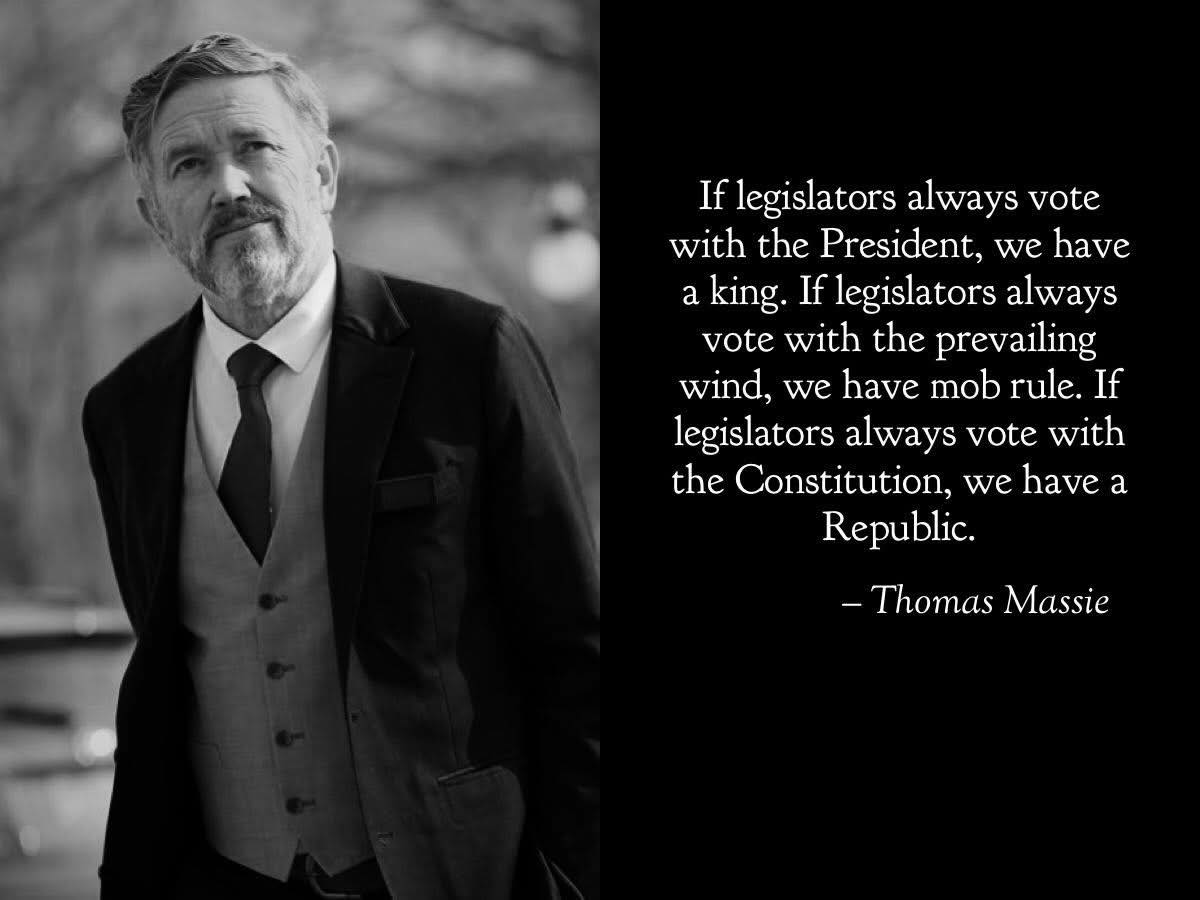
That is the heart of the matter.
Some have perverted and co-opted the word “conservatism” until it means little more than loyalty to the Republican Party. It does not.
Conservatism, properly understood, is not obedience to a president, a party, a donor class, a foreign-policy lobby, or the prevailing political wind. It is fidelity to ordered liberty, constitutional limits, fiscal restraint, private property, individual rights, and republican self-government.
Measured by that standard, Massie’s defeat was not a victory for conservatism.
It was a warning about how easily conservatism can be replaced by team loyalty, how easily constitutional government can be replaced by executive obedience, and how quickly a republic can forget what made it worth preserving.
